

Chapter I
Before the World Knew Her Name
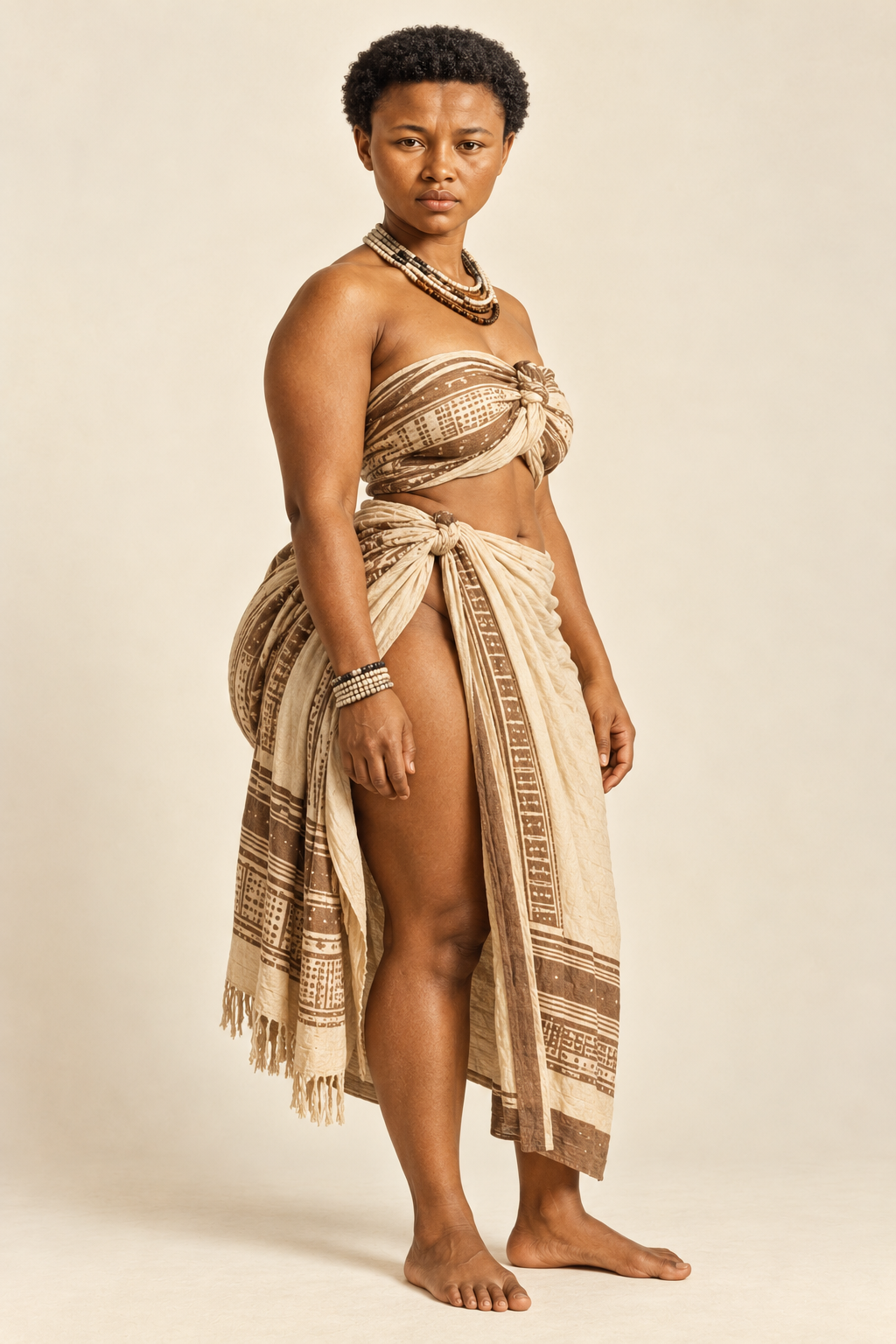
Before the crowds, the commercial notices and the museum records, there was a woman. Sarah Baartman, also recorded as Sara Baartman, was a Khoikhoi, or Khoekhoe, woman from southern Africa, associated with the Gamtoos River region of what is now South Africa’s Eastern Cape. To begin with her humanity is not to supply a story the archive cannot give us. It is to recognise that an archive of exhibition is not the measure of a life.1, 2
Her birth date is uncertain. South African History Online gives 1789 while acknowledging disagreement; the scholarly Oxford biographical entry by Clifton Crais and Pamela Scully places her birth in the 1770s. The familiar account of a woman born around 1789 is therefore one account, not a settled fact. The uncertainty also affects the age we can responsibly assign to her at death.1, 2
Her early life unfolded within the colonial Cape, where expanding settlement and unequal labour relationships constrained Khoekhoe lives. Historical research places her later in Cape Town within a world of domestic service and dependency. Colonial relationships shaped the choices available to her; they cannot be set aside when considering her subsequent journey.2, 3

The surviving record offers only limited access to her childhood and private experiences. We cannot reconstruct her memories, beliefs or aspirations from the descriptions later made of her. This absence is a reason for restraint, not an invitation to invention. A person may be incompletely documented and still deserve complete regard.
Chapter II
The Journey to Europe
In 1810, Baartman travelled to Britain and was publicly exhibited in London. Hendrik Cesars and Alexander Dunlop were involved in the arrangements. The exhibitions were commercial: paying audiences were encouraged to regard an African woman’s body as an exotic curiosity. Racialised marketing converted human difference into a product, and the exhibition’s degrading historical label came to obscure her name.1, 3
That label is not repeated here as a title for Sarah. Its appearance in historical sources tells us about the people and institutions that marketed her, not who she was. Commercial representation is a form of power: those who write the notice determine what the audience is invited to see, and what it is permitted to overlook.
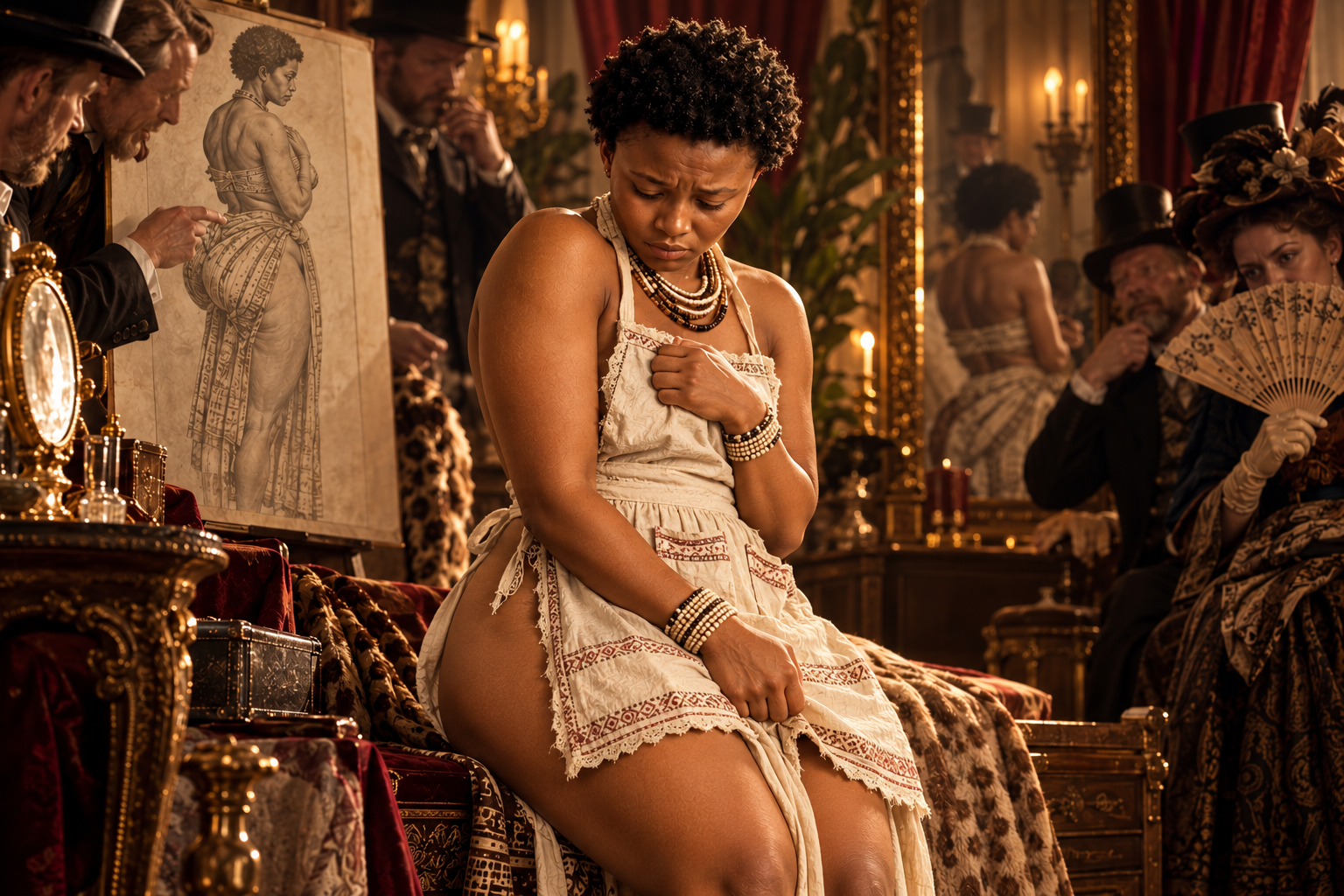
The exhibitions prompted abolitionist intervention and legal investigation. Zachary Macaulay was among those who challenged her treatment. The proceedings included an account of Baartman’s wishes, but scholars emphasise that what survives is a court paraphrase rather than a verbatim transcript of her speech. The case treated her as legally free, and the exhibitions continued.3
The purported agreement, its terms and her personal agency remain subjects of historical debate. It would be misleading either to declare that her participation was unquestionably voluntary or to erase every possibility of action on her part. A legal finding of freedom does not, by itself, establish the absence of economic pressure, dependency or coercion. Responsible history holds these questions open while naming the exploitative structure that is documented.1, 3
Chapter III
The Gaze Becomes a System
Baartman’s exhibition continued in France. The public description of the Muséum national d’Histoire naturelle’s scholarly volume places her Paris appearance in September 1814, followed by examinations by Georges Cuvier and Henri de Blainville in March 1815. Entertainment and scientific scrutiny were not separate moral worlds: both could make her body available to the authority of others.4
European racial theories sought to classify human beings into hierarchies. The examination and description of Baartman formed part of a wider history of racialised and sexualised representation. Supposed scientific authority could lend institutional weight to assumptions that were already structured by colonial power. A collection, a measurement or a learned publication did not make those assumptions neutral or true.2, 4
The historical issue is not that one woman differed from an imagined European norm. It is that a norm was elevated into a standard of human value, and difference was made into a justification for scrutiny and degradation. Colonialism, racism, misogyny and commercial exploitation intersected in this process. Her treatment shows how a person could be approached as evidence for a theory rather than encountered as a human being.2, 4
We do not reproduce degrading historical imagery as spectacle, nor do we present imagined anatomical illustrations as historical evidence. Such records belong to history; their repeated display is not necessary to establish the injustice. Looking critically at a system means asking who authorised it, who benefited from it, and whose boundaries were disregarded—not offering another audience the same invitation to objectify.
Chapter IV
A Life, Not Merely a Symbol
Sarah Baartman died in Paris in December 1815. She is often described as approximately twenty-six, an age derived from the frequently cited 1789 birth year; because that year is disputed, her precise age is uncertain too. The cause of her death is not securely established. Sources differ, and a proposed diagnosis should not be made into a certainty merely because it has been widely repeated.1, 2, 4, 5
After her death, a cast was made of her body and she was dissected. Cuvier was involved in the preservation of her skeleton and organs. Her remains entered museum collections, while the cast was subsequently displayed at the Musée de l’Homme, into the twentieth century. The different elements of this history should not be compressed into the claim that every part of her remains was displayed continuously in the same way.2, 4, 5
Death did not end the institutional claim upon her body. The transition from exhibition to collection extended the reduction of a person to an object. Museums are not outside history: the ways they acquire, name, preserve and display human remains can continue the unequal relationships through which those remains were obtained.
An ethical reflection · Shadow & Shine
What does remembrance require when the surviving record was made largely by those who watched, described or possessed? Not another imagined confession. Not a dramatic voice placed in her mouth. It requires acknowledging the violence of the record while refusing to make that record the whole of her personhood.
Sarah was more than the injustice she endured. We cannot responsibly supply the private thoughts that would make a familiar modern narrative easier to tell. To leave a gap visible can be an act of respect: an admission that another person’s interior life is not ours to claim.
Chapter V
The Long Journey Home
The campaign to return Baartman’s remains challenged the idea that institutions could retain them indefinitely as scientific property. South African requests and sustained advocacy brought remembrance into a question of historical accountability. Her return was not simply the movement of a museum collection across a border. It concerned the recognition of a person and the obligations created by the treatment of her body.1, 7
French legislation dated 6 March 2002 authorised the transfer of her remains to South Africa. That date marks the law, not her arrival. South African governmental records state that her remains arrived on 3 May 2002. Keeping those events distinct matters: a commemoration should be no less careful with dates than a scholarly account.6, 7
9 August 2002
A burial in her homeland.
A responsibility carried forward.
On 9 August 2002, South Africa’s National Women’s Day, Baartman was buried at Vergaderingskop, near Hankey in the Eastern Cape. Governmental speeches confirm the interment date. The burial restored a resting place within her homeland after almost two centuries of removal and institutional possession.1, 7, 8
Homecoming cannot undo what happened. Nor should it be told as a simple ending in which all historical debts are resolved. Its significance lies in the public recognition of those debts: a refusal to accept that the dignity of the dead belongs to the institutions that once held them. Remembrance continues through how histories are taught, how collections are questioned, and how living communities participate in the telling.
Chapter VI
Beyond the Gaze
Beyond the historical record, Sarah’s story asks us to consider the terms on which people become visible. The reflections in this chapter are contemporary Shadow & Shine interpretation, not statements attributed to Sarah and not evidence of her own beliefs. Her life does not need to anticipate our language to deserve our attention.
Patriarchal, racist and misogynistic systems can determine who is permitted to describe a body and whose account of that body is believed. Commercial systems can attach value to appearance while withholding regard for the person. Ageist expectations can narrow the space in which people are seen as desirable, capable or worthy of attention. These are modern questions placed alongside a particular history—not a claim that all experiences of objectification are identical.
Whose humanity is left outside the frame?
Representation is not only an image. It is the caption, the category, the platform and the transaction around it. Who decides what is shown? Who profits? Can the person represented refuse, revise or withdraw? When a body becomes a commodity, the language of choice can conceal unequal conditions. These questions should deepen our attention to agency rather than deny it automatically.
Questions for reflection
- Whose voice is missing from an account I have accepted as complete?
- Does this representation preserve the subject’s humanity, or make difference into a spectacle?
- What responsibility accompanies my attention—as a reader, viewer or creator?
Within Shadow & Shine, inquiry into identity, inherited beliefs and bodily autonomy is a present-day practice. We do not claim Sarah personally endorsed feminist, psychological or spiritual concepts developed after her lifetime. The connection is our responsibility to ask better questions now, not our entitlement to make her speak for us.
Chapter VII
From Shadow into Light
Remembrance must make room for more than injury. Cultural heritage, dignity and historical accountability belong together, but none gives us permission to manufacture a complete life from a damaged archive. The artwork below is a contemporary symbol of regard. It does not recover Sarah’s appearance or reveal how she felt.
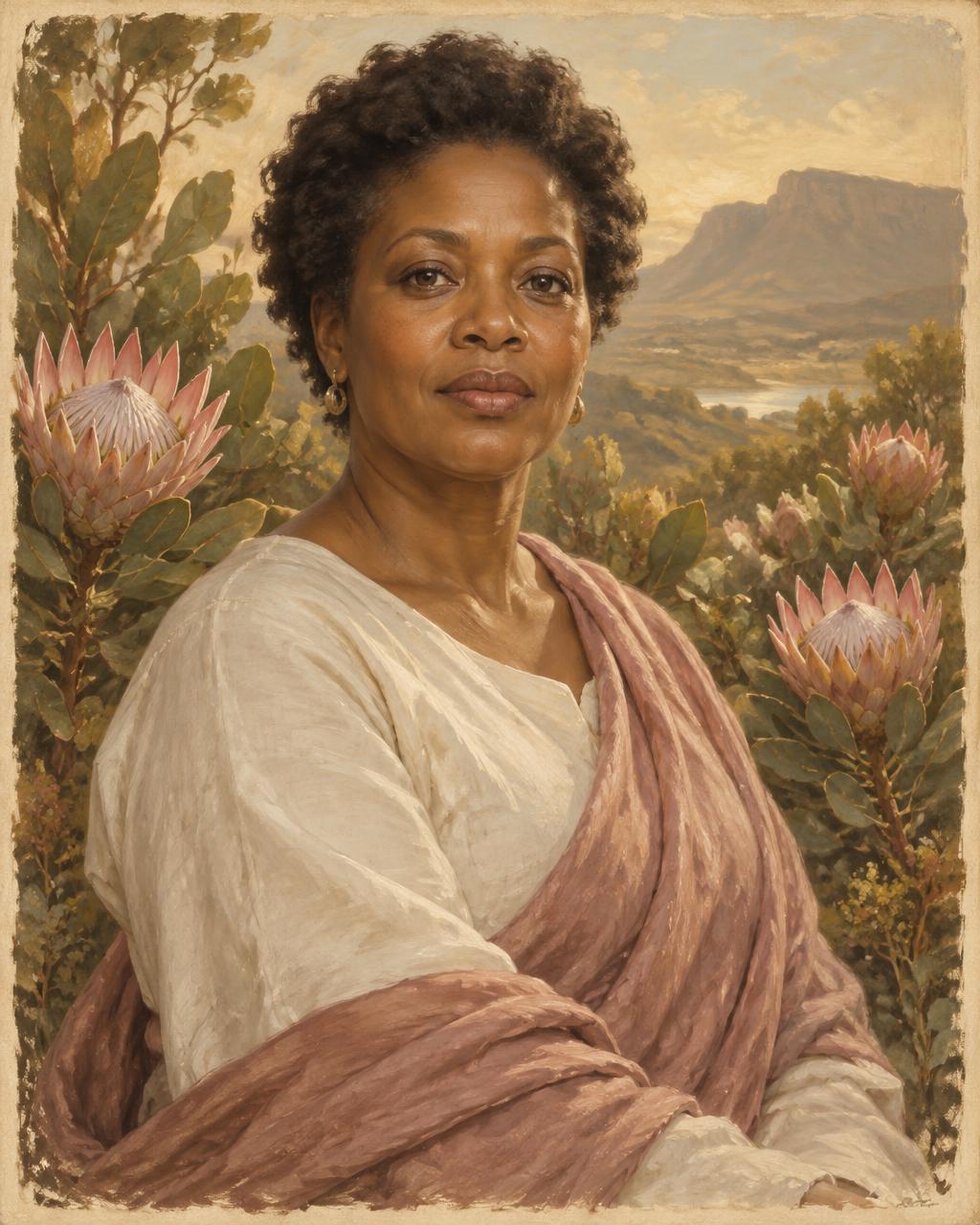
Sarah’s life cannot be reduced to the injustice she endured. Her dignity was never ours to grant. It was always hers.
To remember her responsibly is to acknowledge what happened, respect what we cannot know, and refuse to turn her suffering into another spectacle.
Beyond the gaze, we encounter the responsibility to see a human being.
Beyond the shame.
Beyond the labels.
Shadow & Shine — The Alchemy of You
A companion reflection
The Hall of Human Understanding
Three thinkers. Three perspectives. An invitation to look inward.
None of these men knew Sarah Baartman, witnessed her life, or intervened in it; Freud, the eldest, was born decades after her death. This gallery is a contemporary artistic device that brings their ideas into conversation with the questions her story raises. Their theories differ, have very different relationships to present-day evidence, and nothing here is diagnosis or therapy.
Carl Rogers · 1902–1987
Rogers, an American psychologist, founded the person-centred approach. He emphasised empathy (understanding another’s experience as they live it), unconditional positive regard (acceptance without judgment) and congruence (authenticity), holding that people grow when they are understood rather than labelled.
“The curious paradox is that when I accept myself just as I am, then I can change.”Carl R. Rogers, On Becoming a Person (1961)
Optional prompts for quiet reflection. Nothing you think here is recorded.
Open a reflection
What does it mean to be seen as a whole person?
Open a reflection
How can empathy change the way we interpret another person’s experience?
Open a reflection
What is the difference between looking at someone and trying to understand them?
The three portraits are contemporary artworks, not historical photographs. The wording painted into each portrait is part of the artwork and could not be verified as an exact quotation, so it is not attributed here; the quotations above are drawn from the cited published works.
The research behind the journal
Historical Sources and Further Reading
Editorial note: sources disagree on Baartman’s birth year, age and cause of death. SA History Online also differs from scholarly sources on the death year and from governmental records on the return date. This journal uses December 1815 for her death, distinguishes the March 2002 French law from the May arrival, and follows governmental records for the 9 August burial. Uncertainty is identified rather than silently resolved. The Oxford entry’s publicly indexed abstract, and the museum publisher’s public description, were consulted; no claim of full-text access is made.
- Sara ‘Saartjie’ Baartman (opens in a new tab)
South African History Online
Biographical overview. Its dates differ from other sources; see the editorial note below.
- Baartman, Sara (opens in a new tab)
Clifton Crais and Pamela Scully · Oxford Research Encyclopedia of African History (2020)
Scholarly biographical entry. The publicly indexed abstract informs the discussion of disputed birth dates; full access may require a subscription.
- Race and Erasure: Sara Baartman and Hendrik Cesars in Cape Town and London (opens in a new tab)
Pamela Scully and Clifton Crais · Journal of British Studies (2008)
Research into the London exhibitions, colonial relationships and the legal record.
- La Vénus hottentote : entre Barnum et Muséum (opens in a new tab)
Claude Blanckaert, editor · Muséum national d’Histoire naturelle (2013)
Museum-published scholarly volume; its public description documents Paris exhibition, examinations and posthumous treatment. The title reproduces a derogatory historical label.
- Sara Baartman — biographical record (opens in a new tab)
British Museum · Collections Online
Museum record on exhibition and preservation of remains. Its attribution of smallpox is not treated here as a settled cause of death.
- Law no. 2002-323 of 6 March 2002 (opens in a new tab)
French Republic · Légifrance
Legislation authorizing the return of Sarah Baartman’s remains to South Africa; French-language primary source.
- Competition for the design of the Sarah Baartman Centre of Remembrance (opens in a new tab)
Pallo Jordan · South African Government (9 March 2009)
Records arrival in South Africa on 3 May 2002 and burial at Vergaderingskop on 9 August 2002.
- Unveiling of the Sarah Bartmann Centre of Remembrance (opens in a new tab)
Lulu Xingwana · South African Government (22 August 2010)
Independent governmental confirmation of the 9 August 2002 interment.
The pull quotes and reflective passages are original Shadow & Shine editorial writing, not quotations from Sarah Baartman. All illustrations were created for this journal as contemporary interpretations. The manuscript-inspired styling is not a claim that Sarah lived in the medieval or Victorian periods.